Exercises: Use Rigid Motions to Define and Determine Congruence
Work through each section in order. For problems that ask you to find a rigid motion,
verify your answer by checking every vertex.
Warm-Up: Review What You Know
These problems review skills you already know from earlier in the unit.
Which of the following is the formal definition of a rigid motion?
A transformation that preserves all distances and angle measures between points
A transformation that moves a figure to the same position and orientation
A transformation that preserves shape but may change size
A transformation that includes translations, rotations, reflections, and dilations
Triangle has vertices , , and .
After a translation by vector , what are the coordinates
of the image vertex ?
Which property do all rigid motions (translations, reflections, rotations) share?
They always preserve the orientation (handedness) of a figure
They always move the figure to a new position
They preserve all distances between corresponding points
They require a center point or line to be defined
Fluency Practice
Apply rigid motions and the definition of congruence to answer each problem.
According to the rigid-motion definition, two figures are congruent if and only if:
They have the same perimeter and area
They are in the same position and have the same orientation
There exists a sequence of rigid motions mapping one figure exactly onto the other
There exists a sequence of rigid motions or dilations mapping one figure
onto the other
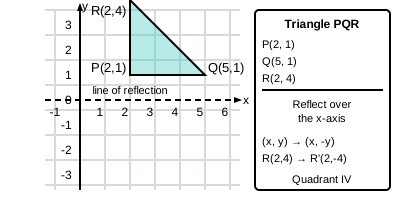
Triangle has vertices , , and .
It is reflected over the -axis. In which quadrant does vertex land,
and does the reflection reverse the orientation of the triangle?
Quadrant III; yes, the reflection reverses orientation
Quadrant IV; yes, the reflection reverses orientation
Quadrant IV; no, the reflection preserves orientation
Quadrant I; no, the reflection preserves orientation
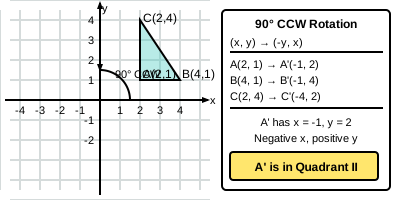
Triangle has vertices , , and .
It is rotated counterclockwise about the origin. Which quadrant
contains the image vertex ?
Quadrant I
Quadrant II
Quadrant III
Quadrant IV
Triangle has vertices , , .
A student claims that to verify a rigid motion maps to a target triangle,
it is sufficient to check that the three vertex images match the three target vertices.
Is this claim correct?
No — every point on every side must be checked individually
No — only the midpoints of each side need to be checked in addition
to the vertices
Yes — rigid motions map line segments to line segments, so if all vertices
match, all points on the sides automatically match
Yes — but only for triangles; for quadrilaterals, you must check diagonals
as well
Triangle has vertices , , and .
Triangle has vertices , , and .
Which single rigid motion maps onto ?
A translation by
A rotation about the origin
A reflection over the -axis
A reflection over the line
You're viewing 2 of 6 sections.
Create a free account to continue the full exercise set and save your progress.
Create free account