Exercises: Apply Similarity and Congruence to Solve Problems
Work through each section in order. For proof problems, state the criterion used (SSS, SAS, ASA, AAS, AA, SAS~, SSS~) and identify CPCTC steps explicitly. Show all work for computation problems.
Warm-Up: Review What You Know
These problems review skills you already know.
Two triangles share a side. You know two angles of the first triangle are congruent to two angles of the second triangle. Which congruence criterion applies?
SSS — three pairs of congruent sides
AAS — two angles and a non-included side are congruent
SAS — two sides and the included angle are congruent
The triangles are congruent because they look the same size
Triangle is similar to triangle with a scale factor of 3. If , what is ?
6 — similar triangles are the same size
18
3
2
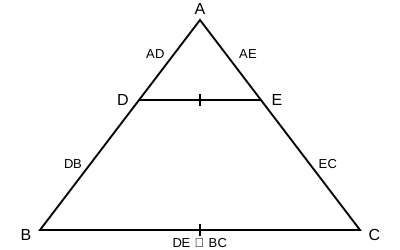
In the diagram, with on and on . Which similarity criterion proves ?
SSS — three pairs of proportional sides
SAS~ — two proportional sides and the included angle
AA — two pairs of congruent angles
SSA — two sides and a non-included angle
Fluency Practice
Apply congruence or similarity criteria directly. State the criterion used.
In parallelogram , diagonal is drawn. You know and . Which criterion proves ?
SSA — two sides and a non-included angle
SAS — , ,
ASA — , ,
SSS — three pairs of congruent sides
In rectangle , , (reflexive), and (both right angles). A student concludes: "By CPCTC, ." Identify the missing step and state the complete proof.
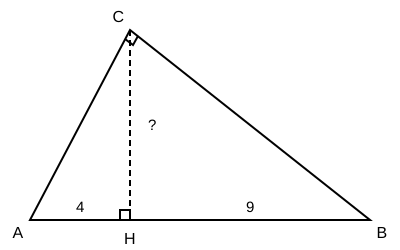
In right triangle with the right angle at , the altitude from to hypotenuse meets at point . If and , find the length of altitude .
In , point is on and point is on such that . Given , , and , find .
In isosceles triangle with , is the midpoint of . Which congruence criterion proves ?
AAS — , ,
SAS — , ,
SSS — , ,
ASA — , ,
You're viewing 2 of 6 sections.
Create a free account to continue the full exercise set and save your progress.
Create free account