Exercises: Prove Theorems Using Similarity
Show all work. For proof problems, write complete reasoning in paragraph or two-column form.
Warm-Up: Review What You Know
These problems review skills from previous lessons.
Two triangles share the same vertex angle . If a second pair of angles is also equal, which similarity criterion guarantees the triangles are similar?
SAS similarity
SSS similarity
AA similarity
HL congruence
Line is parallel to line , and line is a transversal crossing both.
Which statement correctly describes the relationship between and ?
and are supplementary.
and are corresponding angles, so they are equal.
and are alternate interior angles.
and have no relationship unless the lines are perpendicular.
A right triangle has legs of length 5 and 12. What is the length of the hypotenuse?
17
13
169
Fluency Practice
Apply the Side-Splitter Theorem, its converse, or right-triangle similarity to find unknown values.
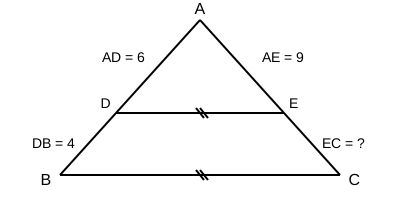
In , segment with on and on .
Given , , and , find .
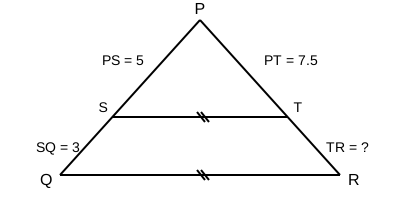
In , segment with on and on .
Given , , and , find .
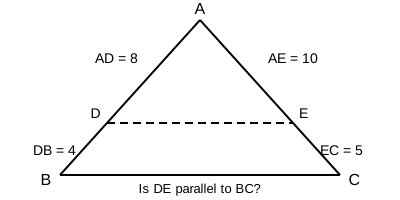
In , point lies on and point lies on .
Given , , , and . Is ?
Yes — the ratios and are equal, so by the converse of the Side-Splitter Theorem, .
No — the ratios are not equal, so is not parallel to .
Yes — divides two sides of the triangle, so it must always be parallel to the third side.
Cannot be determined without knowing the lengths of and .
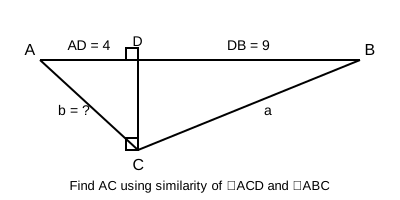
Right triangle has a right angle at . The altitude from meets
hypotenuse at point , with and .
Using the similarity of and , find .
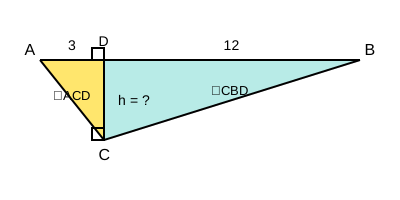
In right with right angle at , altitude meets
hypotenuse at with and .
Using , find the altitude length .
You're viewing 2 of 6 sections.
Create a free account to continue the full exercise set and save your progress.
Create free account