Back to Exercise: Establish AA similarity criterion

Exercises: Establish AA Similarity Criterion

Work through each section in order. Show your reasoning where indicated. For problems that ask you to determine similarity, identify the two angle pairs that allow you to apply AA.

Grade 9·20 problems·~30 min·Common Core Math - HS Geometry·standard·hsg-srt-a-3
Printable layout
A

Warm-Up: Review What You Know

These problems review skills you have already learned.

1

In △ABC\triangle ABC, ∠A=47°\angle A = 47\degree and ∠B=65°\angle B = 65\degree. What is ∠C\angle C?

A.

58°58\degree

B.

112°112\degree

C.

68°68\degree

D.

180°180\degree

2

Which statement best describes the AA (Angle-Angle) criterion for triangle similarity?

A.

If two sides of one triangle are proportional to two sides of another triangle, the triangles are similar.

B.

If two angles of one triangle are congruent to two angles of another triangle, the triangles are similar.

C.

If all three angles of one triangle are congruent to all three angles of another triangle, the triangles are similar.

D.

If two angles of one triangle are congruent to two angles of any polygon, the triangles are similar.

3

A dilation with center OO and scale factor k=3k = 3 maps △PQR\triangle PQR to △P′Q′R′\triangle P'Q'R'. Which of the following is true?

A.

∠P′=3×∠P\angle P' = 3 \times \angle P

B.

∠P′=∠P\angle P' = \angle P and P′Q′=3⋅PQP'Q' = 3 \cdot PQ

C.

∠P′=∠P\angle P' = \angle P and P′Q′=PQP'Q' = PQ

D.

P′Q′=3⋅PQP'Q' = 3 \cdot PQ and ∠P′=13∠P\angle P' = \frac{1}{3} \angle P

B

Fluency Practice

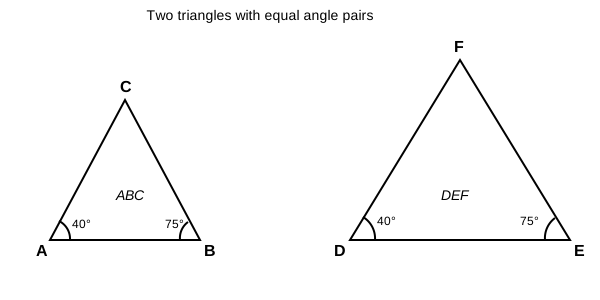
Two triangles. Left triangle ABC has a 40° angle at A and 75° angle at B. Right triangle DEF has a 40° angle at D and 75° angle at E. The right triangle is larger than the left.
1

In the diagram, △ABC\triangle ABC has ∠A=40°\angle A = 40\degree and ∠B=75°\angle B = 75\degree. Triangle △DEF\triangle DEF has ∠D=40°\angle D = 40\degree and ∠E=75°\angle E = 75\degree. Which conclusion is correct?

A.

△ABC≅△DEF\triangle ABC \cong \triangle DEF because two pairs of angles are equal.

B.

△ABC∼△DEF\triangle ABC \sim \triangle DEF by AA, because ∠A=∠D\angle A = \angle D and ∠B=∠E\angle B = \angle E.

C.

The triangles cannot be similar because the third angle ∠C\angle C is not given.

D.

More information about the side lengths is needed to determine similarity.

2

Triangle △PQR\triangle PQR has ∠P=32°\angle P = 32\degree and ∠Q=58°\angle Q = 58\degree. Triangle △XYZ\triangle XYZ has ∠X=32°\angle X = 32\degree and ∠Z=90°\angle Z = 90\degree. Are these triangles similar by AA?

A.

Yes — ∠P=∠X\angle P = \angle X and ∠Q=∠Z\angle Q = \angle Z, so △PQR∼△XYZ\triangle PQR \sim \triangle XYZ by AA.

B.

Yes — ∠P=∠X\angle P = \angle X and ∠R=∠Z\angle R = \angle Z, so △PQR∼△XYZ\triangle PQR \sim \triangle XYZ by AA.

C.

No — only one pair of angles is equal.

D.

No — we need to check all three angle pairs first.
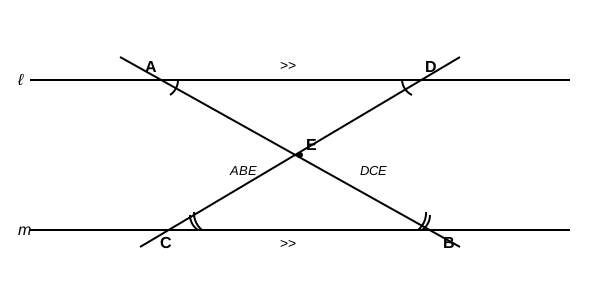
Two parallel lines cut by two transversals meeting at point E between the lines. Triangle ABE on the left and triangle DCE on the right share vertex E. Matching angle marks show angle A equals angle D and angle B equals angle C.
3

In the figure, lines ℓ\ell and mm are parallel, and two transversals intersect them, forming △ABE\triangle ABE and △DCE\triangle DCE as shown. Which pair of triangles is similar by AA, and what is the correct correspondence?

A.

△ABE∼△DCE\triangle ABE \sim \triangle DCE with correspondence A↔DA \leftrightarrow D, B↔CB \leftrightarrow C, E↔EE \leftrightarrow E.

B.

△ABE∼△CDE\triangle ABE \sim \triangle CDE with correspondence A↔CA \leftrightarrow C, B↔DB \leftrightarrow D, E↔EE \leftrightarrow E.

C.

The triangles are not similar because no angle measures are given.

D.

△ABE∼△DCE\triangle ABE \sim \triangle DCE with correspondence A↔CA \leftrightarrow C, B↔DB \leftrightarrow D, E↔EE \leftrightarrow E.

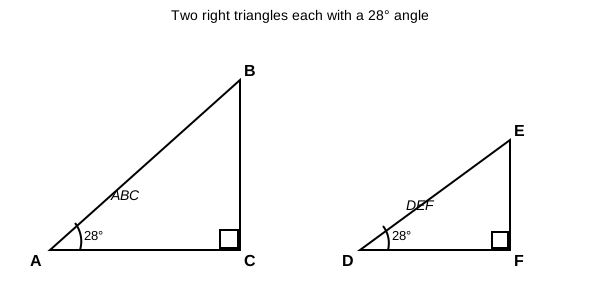
Two right triangles. Left triangle ABC has a right angle at C and 28° at A. Right triangle DEF has a right angle at F and 28° at D. The right triangle is smaller.
4

Right triangle △ABC\triangle ABC has ∠C=90°\angle C = 90\degree and ∠A=28°\angle A = 28\degree. Right triangle △DEF\triangle DEF has ∠F=90°\angle F = 90\degree and ∠D=28°\angle D = 28\degree. Are the triangles similar?

A.

Yes — △ABC∼△DEF\triangle ABC \sim \triangle DEF by AA, because ∠C=∠F=90°\angle C = \angle F = 90\degree and ∠A=∠D=28°\angle A = \angle D = 28\degree.

B.

No — right triangles are only similar if their hypotenuses are proportional.

C.

Yes — all right triangles are similar to each other.

D.

Cannot determine — we need to know the side lengths.

5

Triangle △ABC\triangle ABC has ∠A=50°\angle A = 50\degree, ∠B=70°\angle B = 70\degree, and AB=6AB = 6 cm. Triangle △DEF\triangle DEF has ∠D=50°\angle D = 50\degree, ∠E=70°\angle E = 70\degree, and DE=9DE = 9 cm. Which statement is true?

A.

△ABC∼△DEF\triangle ABC \sim \triangle DEF by AA, and the triangles are also congruent because they share two equal angles.

B.

△ABC∼△DEF\triangle ABC \sim \triangle DEF by AA, with scale factor k=32k = \frac{3}{2} from △ABC\triangle ABC to △DEF\triangle DEF.

C.

The triangles are congruent by ASA because two angles and the included side are given.

D.

The triangles are not similar because their sides are different lengths.

You're viewing 2 of 6 sections.

Create a free account to continue the full exercise set and save your progress.

Create free account