Exercises: Define Similarity Using Transformations
Work through each section in order. Show your reasoning where indicated.
For problems involving figures, identify corresponding parts before checking ratios or angles.
Warm-Up: Review What You Know
These problems review skills from earlier lessons.
A dilation centered at the origin maps triangle onto triangle with scale factor . If , what is ?
5
8
15
25
Two figures are congruent. Which type of transformation sequence maps one onto the other?
A dilation only
A sequence of rigid motions only (translations, rotations, reflections)
A dilation followed by a rigid motion
Any combination of dilations and rigid motions
A dilation with scale factor is applied to a triangle. Which property is preserved (unchanged) by the dilation?
Side lengths
Angle measures
Perimeter
Area
Fluency Practice
A similarity transformation is defined as which sequence of transformations?
One or more dilations only
One or more rigid motions only
Zero or more rigid motions followed by a dilation
A dilation followed by zero or more rigid motions, but never a dilation alone
Triangle is similar to triangle with scale factor . If , what is the length of ?
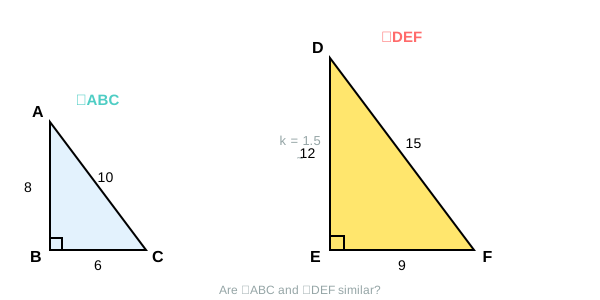
Triangle has sides , , . Triangle has sides , , . Are the triangles similar?
Yes — all three pairs of corresponding sides are proportional with
No — the triangles are different sizes, so they cannot be similar
Yes — but only because they are right triangles
Cannot be determined without knowing the angle measures
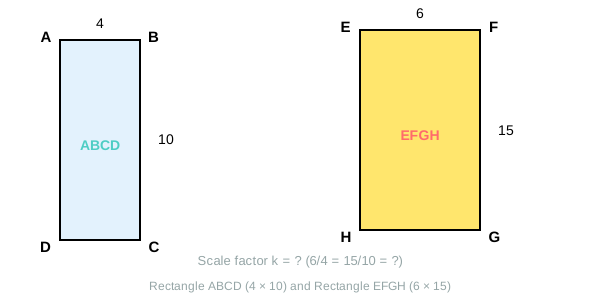
Rectangle has dimensions . Rectangle has dimensions . What is the scale factor from to ?
Triangle triangle with scale factor . If and , what is ?
You're viewing 2 of 6 sections.
Create a free account to continue the full exercise set and save your progress.
Create free account