Back to Exercise: Explain similarity transformations

Exercises: Define Similarity Using Transformations

Work through each section in order. Show your reasoning where indicated. For problems involving figures, identify corresponding parts before checking ratios or angles.

Grade 9·21 problems·~28 min·Common Core Math - HS Geometry·standard·hsg-srt-a-2
Work through problems with immediate feedback
A

Warm-Up: Review What You Know

These problems review skills from earlier lessons.

1.

A dilation centered at the origin maps triangle ABCABC onto triangle ABCA'B'C' with scale factor k=3k = 3. If AB=5AB = 5, what is ABA'B'?

2.

Two figures are congruent. Which type of transformation sequence maps one onto the other?

3.

A dilation with scale factor kk is applied to a triangle. Which property is preserved (unchanged) by the dilation?

B

Fluency Practice

1.

A similarity transformation is defined as which sequence of transformations?

2.

Triangle PQRPQR is similar to triangle STUSTU with scale factor k=2.5k = 2.5. If PQ=8PQ = 8, what is the length of STST?

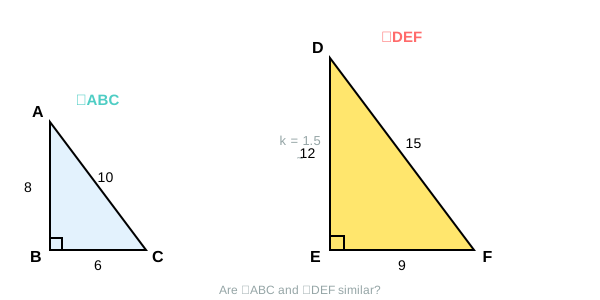
Two right triangles: triangle ABC with sides 6, 8, 10 and triangle DEF with sides 9, 12, 15
3.

Triangle ABCABC has sides AB=6AB = 6, BC=8BC = 8, CA=10CA = 10. Triangle DEFDEF has sides DE=9DE = 9, EF=12EF = 12, FD=15FD = 15. Are the triangles similar?

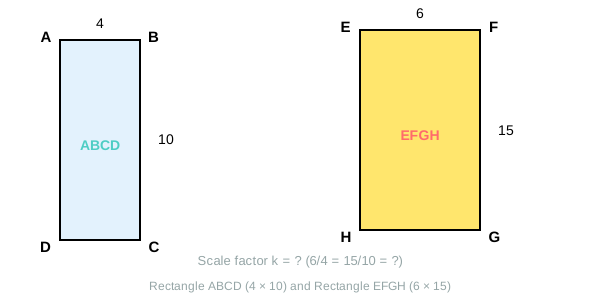
Two rectangles: ABCD with dimensions 4 by 10, and EFGH with dimensions 6 by 15
4.

Rectangle ABCDABCD has dimensions 4×10⁴ \times 10. Rectangle EFGHEFGH has dimensions 6×156 \times 15. What is the scale factor kk from ABCDABCD to EFGHEFGH?

5.

Triangle JKLJKL \sim triangle MNPMNP with scale factor k=3k = 3. If J=47\angle J = 47^\circ and K=68\angle K = 68^\circ, what is N\angle N?

You're viewing 2 of 6 sections.

Create a free account to continue the full exercise set and save your progress.

Create free account
0 of 8 answered

Answer all problems to submit.