Exercises: Apply Geometric Methods to Solve Design Problems
Show your work for each problem. When a problem asks you to round, round to the place the
problem names. Several problems ask you to explain a design decision rather than compute a
number — for those, write in complete sentences.
Warm-Up: Review What You Know
These problems review formulas and ideas you have already learned.
A cylindrical container has radius cm and height cm. What is its volume, in cubic centimeters? Round to the nearest tenth.
A closed cylindrical can has radius cm and height cm. What is its total surface area, including the top and bottom, in square centimeters? Round to the nearest tenth.
A storage bin must fit on a shelf that is cm deep. Which inequality states this requirement, if is the depth of the bin?
, because a bin needs to reach the back wall of the shelf in order to sit stably, so its depth has to be at least the shelf depth.
, because a bin designed for a cm shelf is built to exactly that depth.
, because the bin's depth can be anything up to the shelf depth but no more.
, because the shelf's footprint sets a total area budget, and the bin's depth has to be scaled against that budget rather than against a single length.
Fluency Practice
A cylindrical juice container must hold cm. If its radius is cm, what must its height be, in centimeters? Round to the nearest hundredth.
A designer wants a cylindrical can to hold cm using as little metal as possible. Which quantity should the designer minimize?
The volume , because a can that encloses less space is a smaller object overall, and smaller objects are built from less material.
The surface area , because the metal forms the skin of the can and its area is what gets cut from the sheet.
The radius , because the circular top and bottom are the costly parts, and shrinking the radius shrinks both of them at once.
The height , because the curved side is a rectangle whose length is the height, so a shorter can needs a shorter strip of metal wrapped around it.
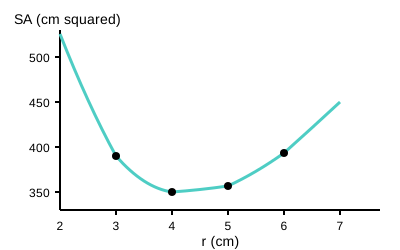
A cylindrical can must hold cm. For each radius below, the height is found from and the surface area from . Complete the table by giving each surface area in square centimeters, rounded to the nearest tenth.
At cm the surface area is ̲ ̲ ̲ ̲ ̲ ̲ ̲ ̲ ̲ ̲ ̲ ̲ ̲ ̲ ̲ ̲ ̲ ̲ ̲ ̲ ̲ ̲ cm. At cm it is ̲ ̲ ̲ ̲ ̲ ̲ ̲ ̲ ̲ ̲ ̲ ̲ ̲ ̲ ̲ ̲ ̲ ̲ ̲ ̲ ̲ ̲ cm. At cm it is ̲ ̲ ̲ ̲ ̲ ̲ ̲ ̲ ̲ ̲ ̲ ̲ ̲ ̲ ̲ ̲ ̲ ̲ ̲ ̲ ̲ ̲ cm. At cm it is ̲ ̲ ̲ ̲ ̲ ̲ ̲ ̲ ̲ ̲ ̲ ̲ ̲ ̲ ̲ ̲ ̲ ̲ ̲ ̲ ̲ ̲ cm.
An open-top box has a square base of side cm and holds cm. How much material does it use, in square centimeters? Count the base and the four sides but not a top. Round to the nearest tenth.
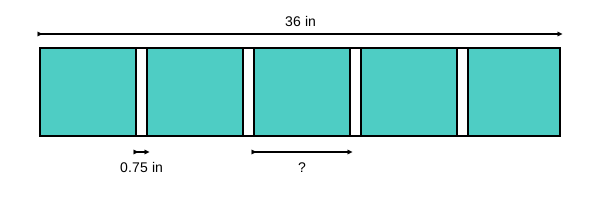
A poster is inches wide and is laid out on a -column grid. Each gap between neighbouring columns is inch, and the columns run to the left and right edges of the poster. How wide is each column, in inches?
A banner inches wide is split into two panels whose widths are in the golden ratio: the wider panel is times the narrower one, and together they fill the full width. How wide is the narrower panel, in inches? Round to the nearest hundredth.
You're viewing 2 of 6 sections.
Create a free account to continue the full exercise set and save your progress.
Create free account