Exercises: Apply Concepts of Density Based on Area and Volume
Show your work for each problem. Every density answer must include its units. When a
problem asks you to type a number, read the stem carefully for the unit and the rounding
it expects.
Warm-Up: Review What You Know
These problems review area, volume, and rate skills you already have.
A rectangular plot of land measures meters by meters. Enter its area in square meters.
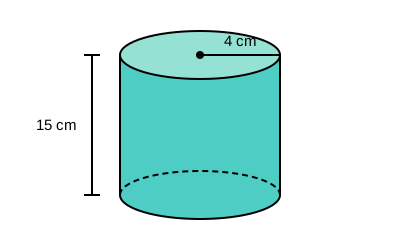
A solid cylinder has a radius of cm and a height of cm. Enter its volume in cubic centimeters, rounded to the nearest whole number.
A car travels miles using gallons of fuel. Which statement correctly describes the rate and its units?
miles per gallon, because is the total distance the car covered on that tank of fuel, and that total is what the trip is measured by.
miles per gallon, because dividing miles by gallons gives the distance covered per single gallon.
miles per gallon, because multiplying miles by gallons combines the two given amounts.
gallons per mile is the only correct rate, because fuel must always be the numerator of a fuel rate.
Fluency Practice
A town has residents spread over an area of square kilometers. Enter the population density as the number of people per square kilometer.
A block of metal has a mass of grams and a volume of cubic centimeters. What is its density?
, since dividing by gives and that number is the density.
, since density compares the volume the metal occupies to each gram of its mass.
, since the mass and the volume both describe the block and are combined to describe it.
, since density is mass divided by volume and the units divide the same way.
Aluminum has a density of . A solid aluminum piece has a volume of . What is its mass?
g, because mass is density multiplied by volume, and leaves grams.
g, because the density and the volume are two amounts of the same material and can be added together.
g, because the density has to be removed from the volume to leave only the mass behind.
g, because density is mass over volume, so the volume is divided by the density to recover the mass.
A metal alloy has a density of . A sample of the alloy has a mass of grams. Enter the volume of the sample in cubic centimeters.
A county reports a population density of people per square mile. Using , what is this density in people per square kilometer?
About people per square kilometer, because the square-mile figure is scaled up by to reach the metric figure.
About people per square kilometer, because the same people are spread over times as many square kilometers as square miles.
About people per square kilometer, because mile is km and that factor converts the area in the denominator.
people per square kilometer, because the county still contains exactly the same residents after the conversion, so the density figure describing them stays at as well.
A ceramic material has a density of . Enter this density in kilograms per cubic meter.
You're viewing 2 of 6 sections.
Create a free account to continue the full exercise set and save your progress.
Create free account