Exercises: Use Geometric Shapes to Describe Objects
Work through each section in order. When you choose a geometric model, say what shape
you picked and why. Use and round as each problem directs.
Warm-Up: Review What You Know
These problems review shape vocabulary and measurement skills you already have.
Nadia measures the diameter of a fence post three times and gets 11.8 cm, 12.0 cm, and 12.1 cm. What should she conclude about her measurements?
The measurements are unusable, because three attempts at the same quantity must agree exactly before any of them can be trusted.
She should discard the two readings that differ from 12.0 cm, since a measurement in whole centimeters is the only kind precise enough to use.
Real measurements carry small uncertainty, so a value near 12 cm is a reasonable estimate of the diameter to work with.
She should average them and treat the result as the post's exact diameter, since averaging removes the uncertainty from a set of readings.
Which of these is an example of someone using geometry to describe a real object?
A student memorizes that the volume of a cylinder is so the formula can be recalled on a test.
A teacher draws a cylinder on the board and labels its radius and height so the class can see the parts of the figure.
A textbook lists cylinders, cones, and spheres together in a chapter on three-dimensional figures.
A forester treats a tree trunk as a cylinder, measures its girth and height, and estimates how much lumber it will yield.
A wooden crate is a rectangular prism measuring 15 cm long, 8 cm wide, and 4 cm tall. What is its volume in cubic centimeters?
Fluency Practice
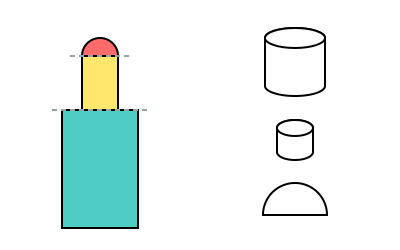
A plastic water bottle has a straight-sided body, a narrower straight neck above it, and a rounded dome cap on top. Which set of shapes models the bottle, part by part, with the fewest pieces that still capture all three sections?
One cylinder for the whole bottle, since the bottle is taller than it is wide and a single shape is always the simplest choice available.
A cylinder for the body, a narrower cylinder for the neck, and a hemisphere for the cap.
A cylinder for the body, a cone for the neck, and a hemisphere for the cap, because the neck is narrower than the body and a cone is the shape that narrows.
A rectangular prism for the body, a narrower rectangular prism for the neck, and a pyramid for the cap, since prisms and pyramids have the flat faces a manufactured container needs.
A grain silo is modeled as a cylinder with radius 3 m and height 12 m. Estimate its volume in cubic meters, rounded to the nearest whole number.
Sand poured from a chute forms a cone-shaped pile with a base radius of 2 m and a height of 6 m. Estimate the pile's volume in cubic meters, rounded to the nearest tenth.
A harbor buoy is modeled as a sphere with a diameter of 0.9 m. Estimate its volume in cubic meters, rounded to the nearest hundredth.
A concrete column is modeled as a cylinder with radius 0.4 m and height 5 m. A crew will wrap the curved side surface only, leaving the flat top and bottom uncovered. How many square meters of wrap are needed, rounded to the nearest tenth?
You're viewing 2 of 6 sections.
Create a free account to continue the full exercise set and save your progress.
Create free account