Exercises: Find the Point Partitioning a Directed Line Segment
Show your work for each problem. Unless a problem says otherwise, a ratio always describes the directed segment read from the first named point to the second. Give coordinates as exact values, using fractions rather than rounded decimals.
Warm-Up: Review What You Know
These problems review skills you have already learned.
What is the midpoint of the segment joining and ?
— average the two -coordinates and average the two -coordinates, since the middle point is halfway along in each direction.
— find the change in and the change in across the segment, then halve each of those changes to land at the middle.
— subtract the first point's coordinates from the second point's coordinates to get the change across the segment, then use that change as the midpoint.
— add the coordinates of the two endpoints together, then halve only the -coordinate of that sum.
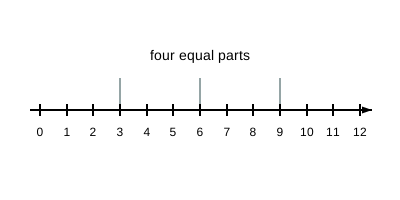
On a number line, what number is of the way from to ?
Two triangles are similar with a scale factor of from the larger to the smaller. The larger triangle has a horizontal leg of length . How long is the corresponding horizontal leg of the smaller triangle?
— multiply the known leg by , using the scale factor upside down so the matching side comes out longer than the one you started from.
— multiply the known leg by the scale factor, since corresponding sides of similar figures are related by that constant multiplier.
— subtract the difference between the two numbers in the scale factor, treating as an amount to remove from the leg length.
— halve the known leg, reading the scale factor as though it meant "cut in half twice as evenly."
Fluency Practice
Which point partitions the directed segment from to in the ratio ?
— split the segment evenly, since a ratio with a in it marks off one equal share on each side of the point.
— travel of the way from toward , reading the ratio directly as the fraction one-third.
— travel of the way from toward , since the ratio divides the segment into equal parts.
— weight by and by , putting the first ratio number on the starting point and the second on the ending point.
Find the point that partitions the directed segment from to in the ratio .
Point partitions the directed segment from to in the ratio . What are the coordinates of ?
— weight by and by , matching the first ratio number to the first point named in the problem.
— move of the way from toward , reading the two ratio numbers as a numerator and a denominator.
— take the midpoint of the segment, since and are close enough in size that the point lands near the center.
— move of the way from toward , since equal parts make up the whole segment.
Find the point that partitions the directed segment from to in the ratio .
Find the point that partitions the directed segment from the origin to in the ratio . Give exact coordinates as fractions.
Which point partitions the directed segment from to in the ratio ?
— take the midpoint of the segment, since a partition point must always fall somewhere in the middle region between the two endpoints.
— weight by and by , attaching the larger ratio number to the point that is written first.
— move times the length of the segment past , reading the ratio as the multiplier .
— move of the way from toward , since the ratio cuts the segment into equal parts.
You're viewing 2 of 6 sections.
Create a free account to continue the full exercise set and save your progress.
Create free account