Exercises: Derive the Equation of a Parabola Given Focus and Directrix
Show your work for each problem. Unless a problem says otherwise, assume the axis of symmetry is horizontal or vertical, and give equations in standard form.
Warm-Up: Review What You Know
These problems review skills you have already learned.
Use the distance formula to find the distance between and .
How far is the point from the horizontal line ?
, found by applying the distance formula from to the point where the line crosses the -axis.
, because the shortest path from a point to a horizontal line is straight down, a change of units in only.
, because the line is and the distance to a line named by a number is that number.
, found by applying the distance formula from to the origin-side point on the line.
Expand .
, since squaring a sum squares each term.
, using the first term, the coefficient , and the square of .
, using with and .
, doubling the for both the middle term and the constant.
Fluency Practice
The parabola has its vertex at the origin. Find the value of , the distance from the vertex to the focus.
What is the directrix of the parabola ?
, placing the directrix on the same side of the vertex as the focus.
, treating the parabola as opening sideways because the equation begins with .
, reading the directrix straight off the coefficient without solving .
, since gives and the directrix of an upward parabola is .
A parabola has focus and directrix . Write its equation in the form .
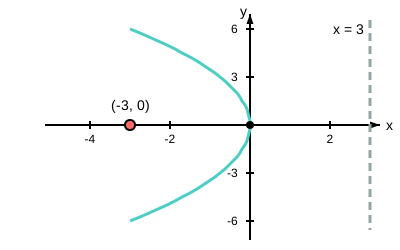
In which direction does the parabola open, and where is its focus?
Left, focus — the squared variable is , so the axis is horizontal, and gives .
Right, focus — the axis is horizontal, and the focus is taken units from the vertex on the positive side.
Down, focus — the negative coefficient means the parabola opens downward from the origin.
Left, focus — the axis is horizontal and the coefficient locates the focus directly.
A parabola has focus and directrix . Write its equation in the form .
The parabola has vertex at the origin. What is its focal length ?
, reading the focal length directly from the coefficient of .
, computing with instead of dividing.
, since means .
, taking the reciprocal of the coefficient without the factor of .
You're viewing 2 of 6 sections.
Create a free account to continue the full exercise set and save your progress.
Create free account