Exercises: Construct Regular Polygons Inscribed in a Circle
Warm-Up
A regular hexagon is inscribed in a circle. What is the central angle subtended by each side of the hexagon?
45°
60°
90°
120°
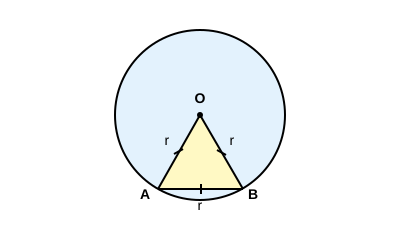
Triangle is drawn with center and two adjacent hexagon vertices and on a circle of radius . All three sides equal . What type of triangle is ?
Scalene
Isosceles
Equilateral
Right
A polygon is inscribed in a circle. What must be true about all vertices of the polygon?
All vertices are at the center of the circle
All vertices lie on the circle
All sides of the polygon are diameters of the circle
All angles of the polygon are right angles
Fluency Practice
To construct a regular hexagon inscribed in a circle of radius , you first draw the circle and mark a starting point . What compass setting do you use to mark the first new vertex on the circle?
Half the radius ()
The radius ()
The diameter ()
A new setting measured by eye to fit the arc
A student constructs a hexagon by walking the compass around the circle. After marking 3 vertices correctly with the compass set to the radius , she resets the compass to a shorter width before marking the remaining vertices. Which statement best identifies her error?
She should have started at a different point on the circle
She should not change the compass width; the side of an inscribed regular hexagon always equals the radius
Six arcs will not fit evenly because small errors accumulate, so adjusting is fine
She marked too many vertices — a hexagon only needs 5 arcs
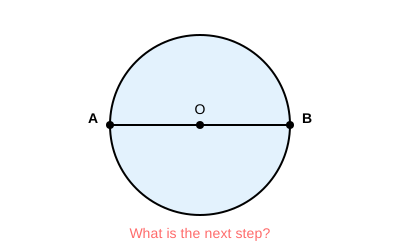
To construct a square inscribed in a circle, you first draw a diameter . What is the correct next step?
Mark two more points using the same compass radius setting as the hexagon construction
Construct the perpendicular bisector of , which passes through center
Draw another diameter at exactly 45° to by estimating with a protractor
Bisect arc by trial and error until four equal arcs are found
A regular hexagon is inscribed in a circle. Which set of vertices, when connected, forms an equilateral triangle inscribed in the same circle?
, , (three consecutive vertices)
, , (every other vertex)
, , (two consecutive, then skipping one)
, (two opposite vertices) and the center
You're viewing 2 of 6 sections.
Create a free account to continue the full exercise set and save your progress.
Create free account