Exercises: Make Formal Geometric Constructions
Work through each section in order. For construction problems, show all compass arcs and straightedge marks — do not erase construction lines. For multiple-choice problems, choose the best answer.
Warm-Up: Review What You Know
These problems review vocabulary and prior knowledge you will need for constructions.
Which statement best describes what a compass does in a geometric construction?
It measures the length of a segment in centimeters.
It draws all points at a fixed distance from a center point.
It draws a straight line through two given points.
It measures the size of an angle in degrees.
A point P is equidistant from endpoints A and B of a segment. On which line does P always lie?
The line through A and B
The perpendicular bisector of segment AB
A line parallel to AB
The angle bisector of angle A
Two triangles have all three pairs of corresponding sides congruent. Which congruence criterion guarantees the triangles are congruent?
ASA (Angle-Side-Angle)
AAS (Angle-Angle-Side)
SSS (Side-Side-Side)
SAS (Side-Angle-Side)
Fluency Practice
Each problem tests your knowledge of the six standard constructions. Identify the correct step, tool use, or construction outcome.
To copy segment AB to a new starting point P, which action correctly transfers the length?
Use a ruler to measure AB in millimeters, then mark the same length from P.
Set the compass width to AB by placing the point at A and pencil at B, then draw an arc from P without changing the width.
Draw a ray from P and estimate where to mark the endpoint by eye.
Place the straightedge so it touches both A and P, then mark where it meets the arc.
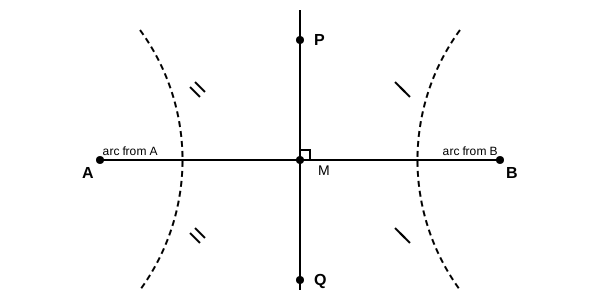
The diagram shows a perpendicular bisector construction on segment AB. Points P and Q are the two intersection points of the arcs drawn from A and B. Which statement correctly justifies why line PQ is perpendicular to AB?
P and Q were drawn by hand to look symmetrical, so the line between them appears perpendicular.
P and Q are each equidistant from A and B, so both lie on the perpendicular bisector of AB by the equidistance theorem.
The arcs cross exactly at the midpoint of AB, so the line through the crossing points is perpendicular.
A and B are the same distance from the line PQ, which means PQ must be vertical.
Valentina is bisecting segment AB. She draws arcs from A and B using a compass set to a radius equal to exactly half the length of AB. Will her construction work?
Yes — setting the radius to exactly half ensures the arcs meet at the midpoint.
No — setting the radius to exactly half means the arcs only just touch at the midpoint and do not produce two distinct intersection points needed to draw the bisector.
No — the radius must be set to exactly the full length of AB for the construction to work.
Yes — the compass radius does not affect where the arcs intersect, so any setting works.
When copying angle DEF to a new vertex V, the construction uses SSS congruence. Fill in the three pairs of congruent sides that make triangles EGH and VJK congruent: , , and .
To construct a line through external point P parallel to line l, the key construction step is to copy a specific angle at P. Which angle must be copied and why?
Copy the angle between the transversal and line l at their intersection point Q, placing the congruent angle at P on the same side of the transversal — this creates equal corresponding angles, guaranteeing parallelism.
Copy the right angle (90 degrees) at the intersection of the transversal and l, so the new line is perpendicular to the transversal.
Copy the angle between the transversal and l at Q, placing it on the opposite side of the transversal at P — this creates alternate interior angles.
Draw a line through P that appears to run alongside l — no angle copying is needed because parallel lines look equidistant.
You're viewing 2 of 6 sections.
Create a free account to continue the full exercise set and save your progress.
Create free account