Exercises: Prove Theorems About Parallelograms
Work through each section in order. Show all proof steps and justifications where indicated.
Warm-Up: Review What You Know
These problems review skills from earlier in the course that you will need for parallelogram proofs.
The midpoints of segment and segment are both the point . What can you conclude?
and bisect each other.
and are congruent.
and are perpendicular.
and are parallel.
Lines and are parallel, and line is a transversal crossing both. Which statement about the alternate interior angles is true?
They are supplementary (they sum to ).
They are congruent.
They are complementary (they sum to ).
They are vertical angles.
In , which reason justifies concluding that ?
Definition of congruent triangles
CPCTC (Corresponding Parts of Congruent Triangles are Congruent)
SAS (Side-Angle-Side)
Reflexive Property
Fluency Practice
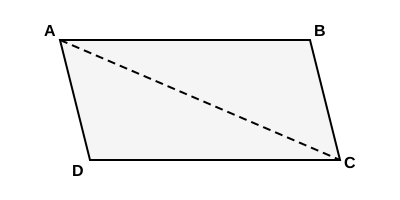
Parallelogram has diagonal drawn. To prove using ASA, a student uses the fact that . Which angle pair does this parallel relationship justify as congruent?
(alternate interior angles, transversal , lines )
(corresponding angles, transversal , lines )
(alternate interior angles, transversal , lines )
(alternate interior angles, transversal , lines )
In parallelogram , it is given that cm and cm. What are the lengths of and ?
cm, cm
cm, cm
cm, cm
cm, cm
In parallelogram , . Find in degrees.
In parallelogram , . Find in degrees.
In quadrilateral , the diagonals and intersect at point , with and . Which conclusion is justified?
is a parallelogram because its diagonals bisect each other.
is a parallelogram because .
is a parallelogram because one pair of opposite sides is congruent.
is a rectangle because the diagonals have different lengths.
You're viewing 2 of 6 sections.
Create a free account to continue the full exercise set and save your progress.
Create free account