Exercises: Triangle Congruence Criteria from Rigid Motions
Work through each section in order. For explanation problems, use complete sentences and reference rigid motions where relevant.
Warm-Up: Review What You Know
These problems review prerequisite skills from CO.B.6, CO.B.7, and Grade 8 geometry.
According to the definition from HSG.CO.B.7, two triangles are congruent if and only if:
All three pairs of corresponding angles are congruent.
There exists a sequence of rigid motions mapping one triangle onto the other.
All three pairs of corresponding sides are congruent.
The triangles have the same area.
CPCTC stands for "Corresponding Parts of Congruent Triangles are Congruent." In a geometric proof, CPCTC is used:
As a reason to establish that two triangles are congruent.
After congruence has been established, to conclude that specific pairs of sides or angles are equal.
To prove that a triangle is isosceles.
As a substitute for identifying which congruence criterion applies.
In triangle , and . What is the measure of ?
Fluency Practice
Two triangles have the following known congruent parts: , , and . The angle is between sides and . Which criterion guarantees the triangles are congruent?
SSS
ASA
SAS
SSA — two sides and a non-included angle
In the SAS rigid-motion proof, after translating vertex to vertex and rotating so that maps to , what forces vertex to land exactly on vertex ?
The included angle forces ray to point in the same direction as ray , and the side length places at the correct distance.
The triangle angle sum forces , which places on .
Two circles centered at and intersect at , determining .
A reflection over line maps to .
In the ASA proof, after aligning side onto (so and ), why is vertex uniquely determined as ?
The side places at the correct distance from .
The angle at forces ray onto ray , and the angle at forces ray onto ray ; their intersection is uniquely .
Two circles centered at and with radii and intersect at .
The third angle is automatically equal, forcing the vertex to coincide.
In and , you know , , and . This is AAS (two angles and a non-included side). Which statement correctly explains why these triangles must be congruent?
AAS is a separate valid criterion, proved independently of ASA.
AAS does not guarantee congruence because the side is not included between the two angles.
Since and , we get ; now , , and is ASA applied to side .
AAS fails like SSA because neither has the side between the two known angles.
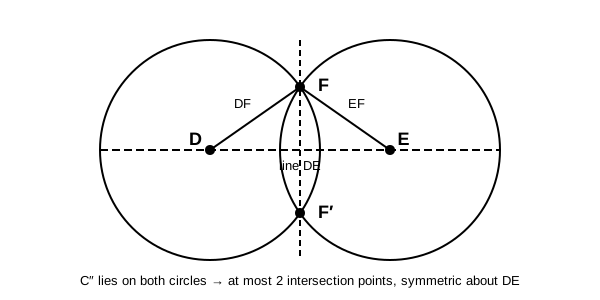
In the SSS rigid-motion proof for (with , , ), after translating to and rotating so maps to , vertex must satisfy and . Why does this guarantee that is either or the reflection of over line ?
Because the angle sum forces .
Because lies on two circles — one centered at with radius , one centered at with radius — and two distinct circles intersect in at most two points, which are symmetric about the line through their centers.
Because SAS applied to the two sub-triangles forces .
Because a translation followed by a rotation always produces a unique image.
You're viewing 2 of 6 sections.
Create a free account to continue the full exercise set and save your progress.
Create free account