Back to Exercise: Explain triangle congruence criteria

Exercises: Triangle Congruence Criteria from Rigid Motions

Work through each section in order. For explanation problems, use complete sentences and reference rigid motions where relevant.

Grade 9·21 problems·~30 min·Common Core Math - HS Geometry·standard·hsg-co-b-8
Work through problems with immediate feedback
A

Warm-Up: Review What You Know

These problems review prerequisite skills from CO.B.6, CO.B.7, and Grade 8 geometry.

1

According to the definition from HSG.CO.B.7, two triangles are congruent if and only if:

2

CPCTC stands for "Corresponding Parts of Congruent Triangles are Congruent." In a geometric proof, CPCTC is used:

3

In triangle △PQR\triangle PQR, ∠P=48∘\angle P = 48^\circ and ∠Q=75∘\angle Q = 75^\circ. What is the measure of ∠R\angle R?

B

Fluency Practice

1

Two triangles have the following known congruent parts: AB‾≅DE‾\overline{AB} \cong \overline{DE}, ∠A≅∠D\angle A \cong \angle D, and AC‾≅DF‾\overline{AC} \cong \overline{DF}. The angle ∠A\angle A is between sides AB‾\overline{AB} and AC‾\overline{AC}. Which criterion guarantees the triangles are congruent?

2

In the SAS rigid-motion proof, after translating vertex AA to vertex DD and rotating so that BB maps to EE, what forces vertex C′′C'' to land exactly on vertex FF?

3

In the ASA proof, after aligning side AB‾\overline{AB} onto DE‾\overline{DE} (so A′′=DA'' = D and B′′=EB'' = E), why is vertex C′′C'' uniquely determined as FF?

4

In △ABC\triangle ABC and △DEF\triangle DEF, you know ∠A≅∠D\angle A \cong \angle D, ∠C≅∠F\angle C \cong \angle F, and BC‾≅EF‾\overline{BC} \cong \overline{EF}. This is AAS (two angles and a non-included side). Which statement correctly explains why these triangles must be congruent?
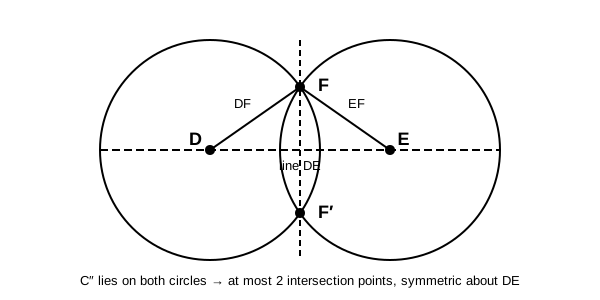
Two overlapping circles centered at D and E. Their two intersection points, F and F-prime, are symmetric about line DE, illustrating the two possible positions for vertex C-double-prime in the SSS proof.
5

In the SSS rigid-motion proof for △ABC≅△DEF\triangle ABC \cong \triangle DEF (with AB=DEAB = DE, AC=DFAC = DF, BC=EFBC = EF), after translating AA to DD and rotating so BB maps to EE, vertex C′′C'' must satisfy DC′′=DFDC'' = DF and EC′′=EFEC'' = EF. Why does this guarantee that C′′C'' is either FF or the reflection of FF over line DEDE?

You're viewing 2 of 6 sections.

Create a free account to continue the full exercise set and save your progress.

Create free account
0 of 8 answered

Answer all problems to submit.

Was this practice set helpful?
Report a problem with this page