Exercises: Prove Triangles Congruent Using Rigid Motions
Work through each section in order. Show your reasoning where indicated.
Warm-Up: Review What You Know
These problems review skills from earlier lessons.
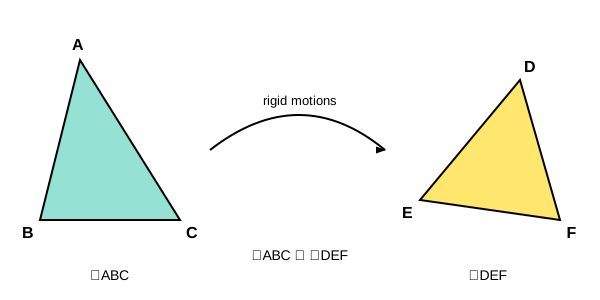
Two figures are congruent (under the rigid-motion definition) if and only if which condition holds?
They have the same area.
A sequence of rigid motions maps one figure exactly onto the other.
They have the same perimeter.
One figure is a scaled copy of the other.
The notation "" tells us that vertex corresponds to vertex , vertex corresponds to vertex , and vertex corresponds to vertex . Under this correspondence, which pair of sides must be congruent?
and
and
and
and
Rigid motions preserve which of the following properties of a figure? Select the best answer.
Side lengths only
Angle measures only
Both side lengths and angle measures
Neither side lengths nor angle measures — only the shape is preserved
Fluency Practice
Apply the biconditional and CPCTC directly.
The biconditional for triangle congruence states: if and only if all corresponding sides and angles are congruent. How many separate congruence conditions does this require?
Three — one for each pair of corresponding sides
Three — one for each pair of corresponding angles
Six — three pairs of sides and three pairs of angles
Two — the biconditional has two directions
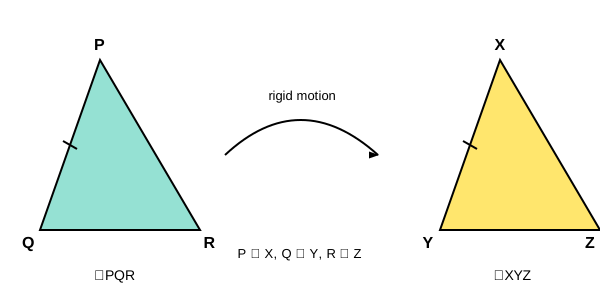
A rigid motion maps onto with , , . Which statement is justified by the forward direction of the biconditional?
because the rigid motion maps to and to , and rigid motions preserve distances.
because both segments are sides of triangles.
because they are the first-listed angles in their respective triangles.
because both triangles have the same shape.
A rigid motion maps onto with , , . Which of the following is NOT directly justified by the preservation properties of rigid motions?
and have the same perimeter
implies
Two triangles have the following measurements. Triangle : , , , , , . Triangle : , , , , , . What does the biconditional guarantee?
The triangles might be congruent, but we need more information.
because all six corresponding parts are equal.
The triangles are similar but not necessarily congruent.
We can only conclude congruence after finding an explicit rigid motion.
In a geometric proof, a student writes: "By CPCTC, ." Which condition must have been established in a prior step for this conclusion to be valid?
Vertices and must be labeled with the same letter in the figure.
The triangles containing and must be congruent.
and must be corresponding angles of parallel lines.
The triangles must share a common side.
You're viewing 2 of 6 sections.
Create a free account to continue the full exercise set and save your progress.
Create free account