Exercises: Define Transformations Formally
Work through each section in order. For problems asking you to state or explain definitions, use precise geometric vocabulary — no coordinates unless specifically requested.
Warm-Up: Review What You Know
These problems review geometric vocabulary from earlier lessons.
Which statement gives the precise geometric definition of parallel lines (from HSG.CO.A.1)?
Two lines that go in the same direction.
Two lines in the same plane that never intersect.
Two lines that are the same distance apart at every point.
Two lines that form four right angles when they cross.
The perpendicular bisector of segment is a line that satisfies two conditions. Which pair correctly states both?
passes through , and is parallel to .
is perpendicular to , and passes through the midpoint of .
bisects at any angle, and passes through one endpoint.
is perpendicular to , and passes through .
According to the CO.A.1 definition, a circle centered at point with radius is the set of all points in the plane that satisfy which condition?
All points whose -coordinate equals .
All points that form a right angle at O.
All points at distance exactly from .
All points that can be connected to O by a straight line.
Fluency Practice
Apply the formal geometric definitions of translation, reflection, and rotation.
The formal definition of a translation along directed segment states that each point maps to such that segment satisfies which three conditions?
is parallel to ; the length of equals the length of ; points in the same direction as .
is perpendicular to ; the length of equals the length of ; is the midpoint of .
The coordinate rule is applied to ; the result equals .
bisects ; the direction from to is counterclockwise; has any length.
Complete the formal definition of a translation: "The translation along maps each point to the point such that is ̲ ̲ ̲ ̲ ̲ ̲ ̲ ̲ ̲ ̲ ̲ ̲ ̲ ̲ ̲ ̲ ̲ ̲ ̲ ̲ ̲ ̲ to , the length of ̲ ̲ ̲ ̲ ̲ ̲ ̲ ̲ ̲ ̲ ̲ ̲ ̲ ̲ ̲ ̲ ̲ ̲ ̲ ̲ ̲ ̲ the length of , and and point in the ̲ ̲ ̲ ̲ ̲ ̲ ̲ ̲ ̲ ̲ ̲ ̲ ̲ ̲ ̲ ̲ ̲ ̲ ̲ ̲ ̲ ̲ direction."
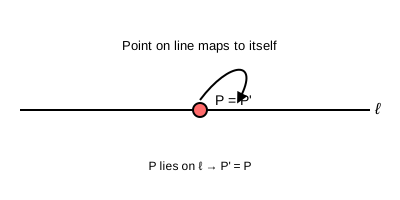
The formal definition of a reflection across line states that maps to such that is the perpendicular bisector of . For a point that lies directly on line , where does map?
P maps to a point on the opposite side of the line at distance 1.
maps to itself ().
maps to the foot of the perpendicular from to .
maps to the reflection of itself.
For a reflection across line : if point is not on , then maps to such that is ̲ ̲ ̲ ̲ ̲ ̲ ̲ ̲ ̲ ̲ ̲ ̲ ̲ ̲ ̲ ̲ ̲ ̲ ̲ ̲ ̲ ̲ to and passes through the ̲ ̲ ̲ ̲ ̲ ̲ ̲ ̲ ̲ ̲ ̲ ̲ ̲ ̲ ̲ ̲ ̲ ̲ ̲ ̲ ̲ ̲ of .
The formal definition of a rotation by angle about center states that maps to such that two conditions hold (when ). Which pair correctly states both conditions?
, and the straight-line distance from to equals .
lies on the perpendicular bisector of , and angle .
(so lies on the circle centered at through ), and the measure of angle .
lies on the same horizontal line as , and angle .
You're viewing 2 of 6 sections.
Create a free account to continue the full exercise set and save your progress.
Create free account