Exercises: Symmetries of Geometric Figures
Work through each section in order. Use precise transformation language in your explanations — state angles of rotation and lines of reflection exactly.
Warm-Up: Transformations Review
These problems review transformation concepts you have already studied.
A rigid motion is applied to a figure. Which property is preserved?
Position of the figure
Both distance between points and angle measures
Only angle measures, not distances
Only distances, not angle measures
Which statement about the identity transformation is correct?
The rotation is a different transformation from the identity.
The identity maps every point to itself and is always a symmetry of every figure.
The identity is not considered a symmetry because it does not move any points.
The identity is a translation by zero units.
In your own words, explain what it means for a rigid motion to "carry a figure onto itself." Use the phrase "maps the figure to itself" in your answer.
Fluency Practice
Identify the rotational and reflective symmetries of each figure.
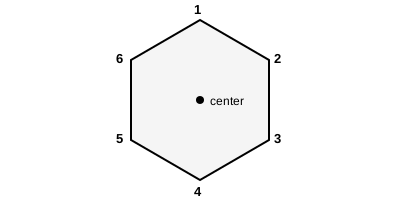
A regular hexagon is centered at the origin. Which list shows all distinct rotational symmetry angles (in degrees, greater than and less than )?
only
, , , , ,
, , , ,
, ,
A regular polygon has rotational symmetry at every multiple of (starting from , up to but not including ). How many sides does this regular polygon have?
A regular pentagon is centered at a fixed point. What is the smallest positive angle of rotation (in degrees) that maps the pentagon onto itself?
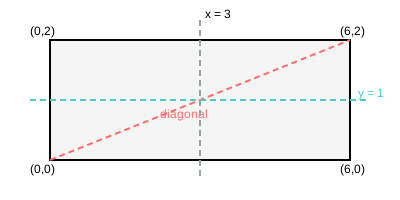
A non-square rectangle has vertices at , , , and . Which of the following is a line of reflective symmetry for this rectangle?
The diagonal from to
The line (horizontal midline)
The line
Any line through the center
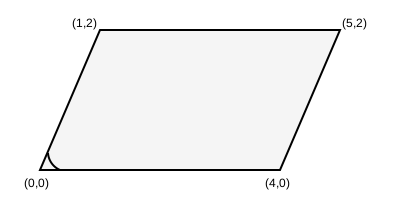
A parallelogram has vertices at , , , and . This is a non-rectangular parallelogram (adjacent sides have different lengths and angles are not right angles). How many lines of reflective symmetry does it have?
You're viewing 2 of 6 sections.
Create a free account to continue the full exercise set and save your progress.
Create free account