Back to Exercise: Understand that a two-dimensional figure is similar to another if the second can be obtained from the first by a sequence of rotations, reflections, and dilations

Exercises: Understand Similarity Through Sequences of Transformations

Work through each section in order. A dilation centered at the origin with scale factor $k$ maps $(x, y)$ to $(kx, ky)$. The scale factor is the ratio of corresponding side lengths. Show your work where indicated.

Grade 8·21 problems·~35 min·Common Core Math - Grade 8·container·8-g-a-4
Work through problems with immediate feedback
A

Recall / Warm-Up

These problems review skills you already know: corresponding sides, dilation rules, and the three rigid motions.
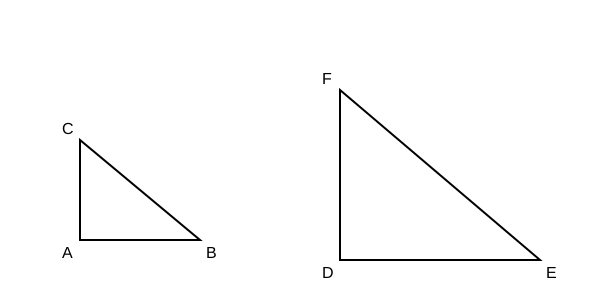
A small triangle ABC beside a larger same-shape triangle DEF.
1.

Triangle ABCABC is similar to triangle DEFDEF, written ABCDEF\triangle ABC \sim \triangle DEF. In this statement, which side of DEF\triangle DEF corresponds to side ABAB of ABC\triangle ABC?

2.

A sequence of transformations uses only translations, reflections, and rotations (no dilation). Two figures connected by such a sequence are always which of the following?
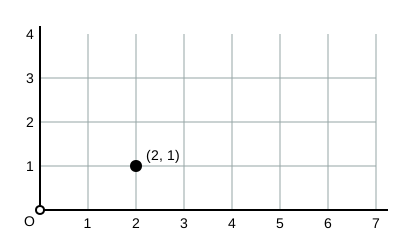
A coordinate grid with a point at (2, 1) and the origin marked.
3.

A dilation centered at the origin with scale factor 33 is applied to the point (2,1)(2, 1). What is the x-coordinate of the image point?

B

Fluency Practice

Find scale factors, check proportionality, and describe transformation sequences. Show your work.
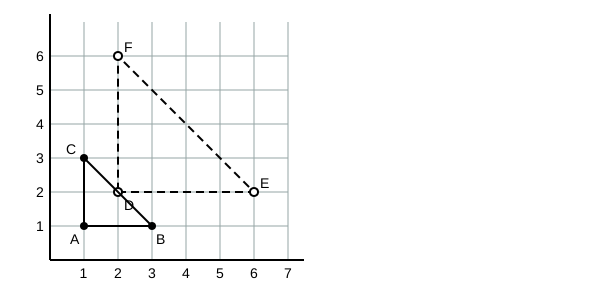
A coordinate grid showing a small triangle ABC and a larger triangle DEF of the same shape.
1.

Triangle ABCABC has vertices A(1,1)A(1, 1), B(3,1)B(3, 1), C(1,3)C(1, 3). Triangle DEFDEF has vertices D(2,2)D(2, 2), E(6,2)E(6, 2), F(2,6)F(2, 6), and ABCDEF\triangle ABC \sim \triangle DEF. Using corresponding sides ABAB and DEDE, what is the scale factor from ABC\triangle ABC to DEF\triangle DEF?

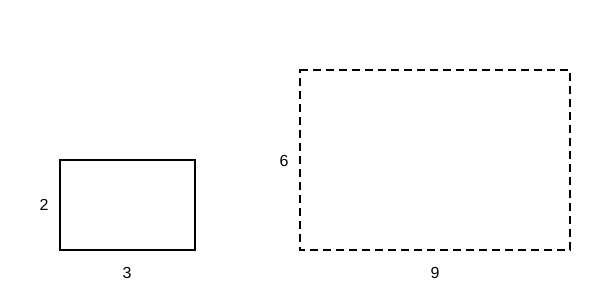
A small 3 by 2 rectangle beside a larger 9 by 6 rectangle of the same proportions.
2.

Rectangle ABCDABCD is 33 units wide and 22 units tall. Rectangle EFGHEFGH is 99 units wide and 66 units tall, and the two rectangles are similar. What is the common ratio of each side of EFGHEFGH to its corresponding side of ABCDABCD (the scale factor)?

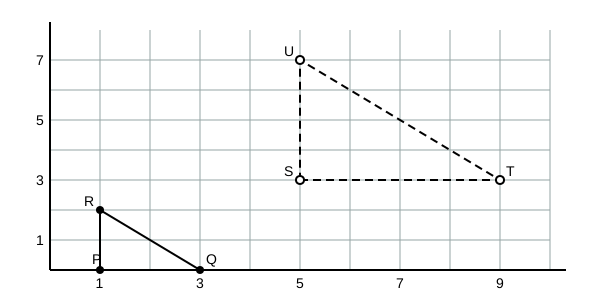
A coordinate grid showing triangle PQR near the origin and a larger triangle STU shifted up and to the right.
3.

Triangle PQRPQR has vertices P(1,0)P(1, 0), Q(3,0)Q(3, 0), R(1,2)R(1, 2). Triangle STUSTU has vertices S(5,3)S(5, 3), T(9,3)T(9, 3), U(5,7)U(5, 7), and the triangles are similar with scale factor 22. Which sequence maps PQR\triangle PQR onto STU\triangle STU?

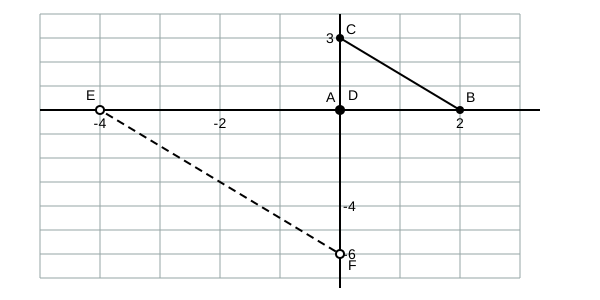
A coordinate grid showing triangle ABC in the first quadrant and a larger triangle DEF in the third quadrant.
4.

Triangle ABCABC has vertices A(0,0)A(0, 0), B(2,0)B(2, 0), C(0,3)C(0, 3). Triangle DEFDEF has vertices D(0,0)D(0, 0), E(4,0)E(-4, 0), F(0,6)F(0, -6), and the triangles are similar with scale factor 22. Which sequence maps ABC\triangle ABC onto DEF\triangle DEF?

5.

Two similar triangles have corresponding sides in the ratio 156\frac{15}{6}. A student must report the scale factor as a fully reduced fraction. What is the scale factor? Write it as a fraction.

You're viewing 2 of 6 sections.

Create a free account to continue the full exercise set and save your progress.

Create free account
0 of 8 answered

Answer all problems to submit.