Back to Understand that a two-dimensional figure is similar to another if the second can be obtained from the first by a sequence of rotations, reflections, and dilations — Problem 1 · Task Set 24
Exercises: Understand Similarity Through Sequences of Transformations
Work through each section in order. A dilation centered at the origin with scale factor maps to . The scale factor is the ratio of corresponding side lengths. Show your work where indicated.
Grade 8·21 problems·~35 min·Common Core Math - Grade 8·container·8-g-a-4
Work through problems with immediate feedback
A
Fluency Practice
Find scale factors, check proportionality, and describe transformation sequences. Show your work.
1.
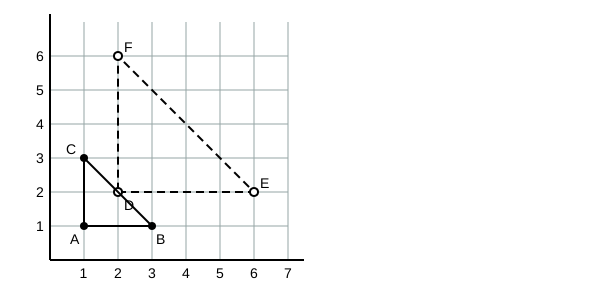
Triangle has vertices , , . Triangle has vertices , , , and . Using corresponding sides and , what is the scale factor from to ?