Back to Exercise: Understand that a two-dimensional figure is congruent to another if the second can be obtained from the first by a sequence of rotations, reflections, and translations

Exercises: Congruence Through Sequences of Rigid Motions

Work through each section in order. When you describe a sequence of rigid motions, name each transformation in order and give its parameters: direction and distance for a translation, the line of reflection for a reflection, and the center and angle (with direction) for a rotation. Two figures are congruent only when a sequence of rigid motions maps one exactly onto the other.

Grade 8·21 problems·~35 min·Common Core Math - Grade 8·container·8-g-a-2
Work through problems with immediate feedback
A

Recall / Warm-Up

These problems review skills you already know: performing single rigid motions and comparing measurements.
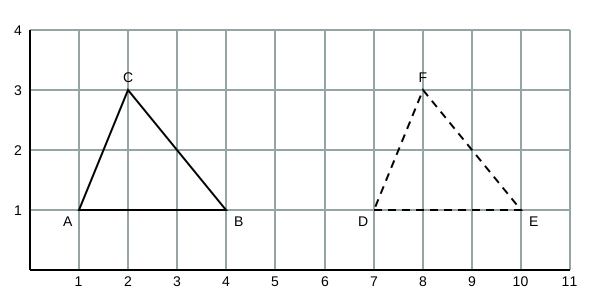
A coordinate grid with triangle ABC on the left and a congruent dashed triangle DEF the same shape farther right.
1

Triangle ABCABC has vertices A(1,1)A(1, 1), B(4,1)B(4, 1), C(2,3)C(2, 3). Triangle DEFDEF has vertices D(7,1)D(7, 1), E(10,1)E(10, 1), F(8,3)F(8, 3). Which single transformation maps ABCABC onto DEFDEF?

2

Which list contains only rigid motions (transformations that keep a figure the same size and shape)?

3

Two triangles have side lengths of 33, 44, 55 and 33, 44, 55. A third triangle has side lengths 33, 44, 66. Rigid motions never change a length. Which pair of triangles could possibly be congruent?

B

Fluency Practice

For each pair of congruent figures, describe a sequence of rigid motions that maps the first onto the second. Name each transformation in order, with its parameters.
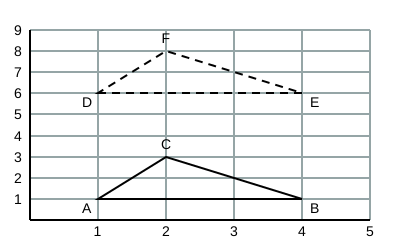
A coordinate grid showing triangle ABC near the bottom and a congruent dashed triangle DEF directly above it.
1

Triangle ABCABC has vertices A(1,1)A(1, 1), B(4,1)B(4, 1), C(2,3)C(2, 3). Triangle DEFDEF has vertices D(1,6)D(1, 6), E(4,6)E(4, 6), F(2,8)F(2, 8). Describe a single rigid motion that maps ABCABC onto DEFDEF, and explain why this proves ABC≅DEFABC \cong DEF.

A coordinate grid showing solid triangle ABC in the first quadrant and a congruent dashed triangle DEF turned around in the third quadrant.
2

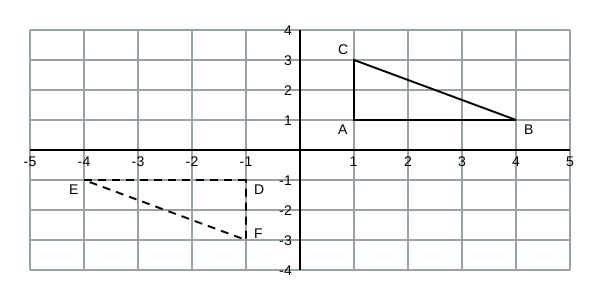
Triangle ABCABC has vertices A(1,1)A(1, 1), B(4,1)B(4, 1), C(1,3)C(1, 3). Triangle DEFDEF has vertices D(−1,−1)D(-1, -1), E(−4,−1)E(-4, -1), F(−1,−3)F(-1, -3). A single motion is not enough. Describe a sequence of two rigid motions that maps ABCABC onto DEFDEF, naming each step in order.

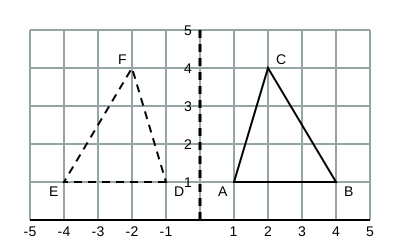
A coordinate grid showing triangle ABC on the right of the y-axis and its mirror-image dashed triangle DEF on the left.
3

Triangle ABCABC has vertices A(1,1)A(1, 1), B(4,1)B(4, 1), C(2,4)C(2, 4). Triangle DEFDEF has vertices D(−1,1)D(-1, 1), E(−4,1)E(-4, 1), F(−2,4)F(-2, 4). Describe a single rigid motion that maps ABCABC onto DEFDEF.

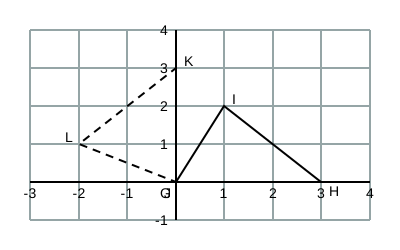
A coordinate grid showing triangle GHI pointing right and a congruent dashed triangle JKL pointing up, sharing the origin.
4

Triangle GHIGHI has vertices G(0,0)G(0, 0), H(3,0)H(3, 0), I(1,2)I(1, 2). Triangle JKLJKL has vertices J(0,0)J(0, 0), K(0,3)K(0, 3), L(−2,1)L(-2, 1). They share the vertex G=JG = J. Which single rigid motion maps GHIGHI onto JKLJKL?

5

Point P(2,5)P(2, 5) is rotated 90°90\degree clockwise about the origin using the rule (x,y)→(y,−x)(x, y) \rightarrow (y, -x). What are the coordinates of the image point P′P'? Write your answer in the form (a,b)(a, b).

You're viewing 2 of 6 sections.

Create a free account to continue the full exercise set and save your progress.

Create free account
0 of 8 answered

Answer all problems to submit.

Was this practice set helpful?
Report a problem with this page