Exercises: Informal Arguments for Sphere Volume Using Cavalieri's Principle
Recall / Warm-Up
Fluency Practice
Two solids each have height 8 cm. At every height between 0 and 8 cm, the cross-sectional area of Solid A equals the cross-sectional area of Solid B. By Cavalieri's principle, if Solid A has volume cm³, what is the volume of Solid B in cm³?
A hemisphere of radius cm is compared to a cylinder-minus-cone solid, where both the cylinder and the cone have radius 6 cm and height 6 cm. What is the volume of the cylinder-minus-cone solid in terms of ?
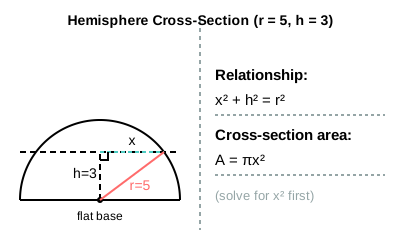
A hemisphere of radius cm is sliced horizontally at height cm above its flat base. Using the Pythagorean Theorem, find the cross-sectional area at that height. Express your answer in terms of .
For a hemisphere of radius , at height above the flat base, the cross-sectional radius satisfies ̲ ̲ ̲ ̲ ̲ ̲ ̲ ̲ ̲ ̲ ̲ ̲ ̲ ̲ ̲ ̲ ̲ ̲ ̲ ̲ ̲ ̲ . So the cross-sectional area is ̲ ̲ ̲ ̲ ̲ ̲ ̲ ̲ ̲ ̲ ̲ ̲ ̲ ̲ ̲ ̲ ̲ ̲ ̲ ̲ ̲ ̲ .
For the cylinder-minus-cone comparison solid (cylinder radius , height ; cone apex at base, base radius at top), at height the cone's inner radius equals ̲ ̲ ̲ ̲ ̲ ̲ ̲ ̲ ̲ ̲ ̲ ̲ ̲ ̲ ̲ ̲ ̲ ̲ ̲ ̲ ̲ ̲ . The annular cross-sectional area is ̲ ̲ ̲ ̲ ̲ ̲ ̲ ̲ ̲ ̲ ̲ ̲ ̲ ̲ ̲ ̲ ̲ ̲ ̲ ̲ ̲ ̲ .
You're viewing 2 of 6 sections.
Create a free account to continue the full exercise set and save your progress.
Create free accountAnswer all problems to submit.