Exercises: Prove Triangles Congruent Using Rigid Motions
Work through each section in order. Show your reasoning where indicated.
Warm-Up: Review What You Know
These problems review skills from earlier lessons.
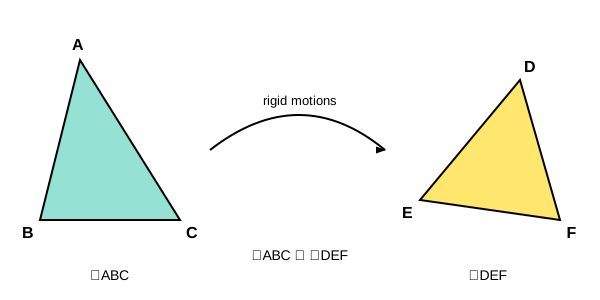
Two figures are congruent (under the rigid-motion definition) if and only if which condition holds?
The notation "" tells us that vertex corresponds to vertex , vertex corresponds to vertex , and vertex corresponds to vertex . Under this correspondence, which pair of sides must be congruent?
Fluency Practice
Apply the biconditional and CPCTC directly.
The biconditional for triangle congruence states: if and only if all corresponding sides and angles are congruent. How many separate congruence conditions does this require?
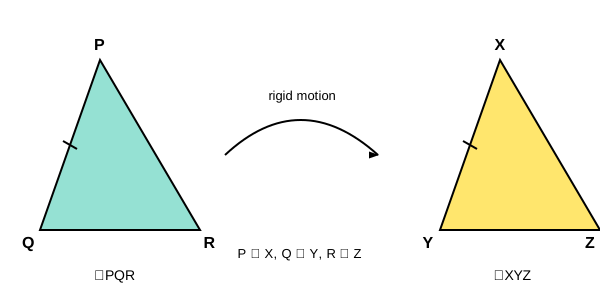
A rigid motion maps onto with , , . Which statement is justified by the forward direction of the biconditional?
A rigid motion maps onto with , , . Which of the following is NOT directly justified by the preservation properties of rigid motions?
Two triangles have the following measurements. Triangle : , , , , , . Triangle : , , , , , . What does the biconditional guarantee?
You're viewing 2 of 6 sections.
Create a free account to continue the full exercise set and save your progress.
Create free accountAnswer all problems to submit.