Back to Understand that a two-dimensional figure is congruent to another if the second can be obtained from the first by a sequence of rotations, reflections, and translations — Problem 4 · Task Set 22
Exercises: Congruence Through Sequences of Rigid Motions
Work through each section in order. When you describe a sequence of rigid motions, name each transformation in order and give its parameters: direction and distance for a translation, the line of reflection for a reflection, and the center and angle (with direction) for a rotation. Two figures are congruent only when a sequence of rigid motions maps one exactly onto the other.
Grade 8·21 problems·~35 min·Common Core Math - Grade 8·container·8-g-a-2
Work through problems with immediate feedback
A
Fluency Practice
For each pair of congruent figures, describe a sequence of rigid motions that maps the first onto the second. Name each transformation in order, with its parameters.
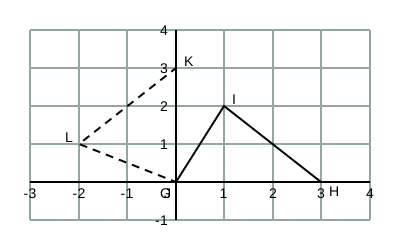
1.
Triangle has vertices , , . Triangle has vertices , , . They share the vertex . Which single rigid motion maps onto ?